

Please note that due to the many Budd cars owned by the CB&Q for it's various other Zephyr name trains, some were occasionally intermixed into the California Zephyr consists in later years. Only cars built specifically for California Zephyr use are covered below.
(Click here to jump to the Roster)
Equipment Specifications and Technical Details
The stainless steel cars which made up the California Zephyr were manufactured by The Budd Company of Philadelphia, Pennsylvania in their Red Lyon plant. Built of 18-8 stainless steel and assembled by Budd's "shot weld" construction method, the cars were built with comfort and durability in the forefront of design criteria. The baggage cars measured 72 feet in length while all other cars measured 85 feet long.
Nine major color schemes were employed throughout the train. Three of these were utilized in the Dome Chair Coaches with each of the other car types having their own. Certain features of the decorations where employed to unitize the overall effect throughout the train. These unifying features included the original murals of western subjects used throughout the train. The murals applied in the coaches and buffets were in oil paints, while those in the diner and bar areas of the buffet-lounge and dome observation were done in multiple mediums such as carved and painted linoleum and etched glass.
Originally the entire train was provided with radio and public-address systems. Due to difficulties maintaining their proper operation, these were later disabled to a certain extent. As originally equipped, two two-wire spool recorders were installed to allow up to twelve hours of continuous musical entertainment. A Western Electric radio system consisting of two separate sets was also installed. These sets were each equipped with seventeen pre tuned crystal receivers, allowing for a total availability of thirty-four broadcasting radio stations. The equipment was controlled from a master control adjacent to the steward's desk. The public-address system is also operated from this control panel. Utilizing a handset, a pushbutton caused radio or wire recorded programs to be cut out, allowing for public announcements to be made. (Views of the controls my be seen on the Zephyrette History page).
With the exception of the diner, all cars are equipped with 25kw Safety genemotors and Spicer drives. They are also equipped with Exide storage batteries with a 1294 amp. hour capacity. The diner was equipped with a 30kw genemotor and 2588 amp. hour batteries. Motor alternators of 2kw capacity converted 32 volts D.C. power to 110 volt A.C. power. Cars having heavy A.C. electrical loads were fitted with two motor alternators. Operation of them in split loads allowed one to shutdown at night when loads were light. These alternators supplied power for fluorescent lighting, razor outlets, vacuum cleaner outlets, electrostatic air filters, radios and the public-address system. Air conditioning systems, incandescent lighting and water coolers were powered from the unconverted D.C. system.
Fluorescent lighting was used in all common passenger spaces. Incandescent reading lights were installed in each roomette and under the overhead baggage racks in each coach. One coach reading light was installed per seat and are individually adjustable. Incandescent lamps were also used to light toilets, vestibules, passageways, kitchen, crew's quarters and porters' areas.
Lighting for the domes was laid out so that illumination progresses from a high intensity to a very low level as you ascended the stairs at night. This was to eliminate interior glare on the dome glass and allow night viewing by passengers.
The cars were cooled by use of Frigidaire electro-mechanical air-conditioning units. Ten ton units were utilized in all cars with the exception of the sleepers; seven ton units were employed on these cars. The dome cars contained two evaporator units, a six ton unit for cooling the front and rear main passenger areas, and a four ton unit for cooling the dome and under dome areas. Cooling of the main diner required six tons, while the equivalent of four tons was utilized for cooling the kitchen area. Frigidaire electro-mechanical refrigeration units were installed in the kitchen as well as the buffet areas of the buffet-lounge and observation car for food storage. These units also provided for manufacture of ice.
Heating of the train was accomplished through the use of a Vapor Zone Control system. Vapor water heaters with a Westinghouse water raising system were utilized in the lavatories. National Aluminate water softeners were installed on all cars for system water, but not drinking water. Drinking water was supplied through a Lundy circulating water cooling system. Each car contained a 500 gallon underbody water tank. The diner had an additional 100 gallon capacity in the kitchen which was connected to the water heater.
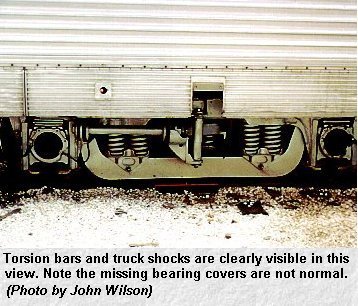
All cars rode on General Steel Casting equalizer type trucks made
of alloy steel. They were equipped with machine balanced 36 inch rolled
steel wheels installed on 6 inch by 11inch axles, riding on Timken rolling
bearings. Coil bolster springs and Houde shocks were used on each truck.
Rubber pads were placed under the center plates, under the equalizers over
each journal box and at the ends of the bolsters.
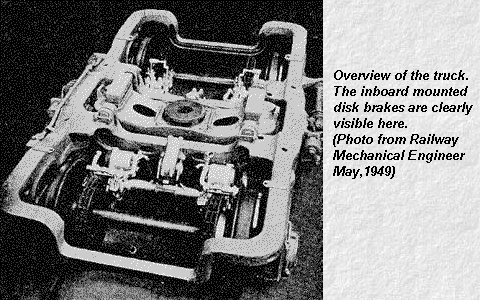
Budd disk brakes were installed on the inboard sides of each wheel.
The air brake system employed was a Westinghouse HSC type with an American
Brake Shoe anti-wheel-slide device. A National type hand brake operated
through the disk brakes on one pair of wheels only. Couplers were National
tight-lock with Waughmat draft gear.
All brake, steam and water piping on the cars was copper line with
Walseal fittings. Air brake piping on the trucks was made of extra heavy
wrought iron. All propane piping and fittings used on the diner were made
of brass.
| Light Weight | Operating Weight | Maximum Load | |
| Baggage | 103,900 | 120,500 | 167,350 |
| Coaches | 148,700 | 154,300 | 165,700 |
| Buffet-Lounge | 155,620 | 163,520 | 171,620 |
| Diner | 148,150 | 160,300 | 169,400 |
| 16 sec. Sleeper | 136,410 | 143,000 | 148,300 |
| 10/6 Sleeper | 142,350 | 149,150 | 152,850 |
| Observation | 151,030 | 159,250 | 168,550 |